Crystal Ball Housing Forecast sees slowdown coming to Greater Victoria
Published 5:00 pm Thursday, January 15, 2026




Real estate analysts and industry representatives suspect that the years of rapid development in Greater Victoria may be coming to an end.
The Victoria Residential Business Association (VRBA) held its annual Crystal Ball Housing Forecast Wednesday (Jan. 14) at the Gorge Vale Golf Club, where industry professionals shared their views to help contractors, realtors, designers and suppliers.
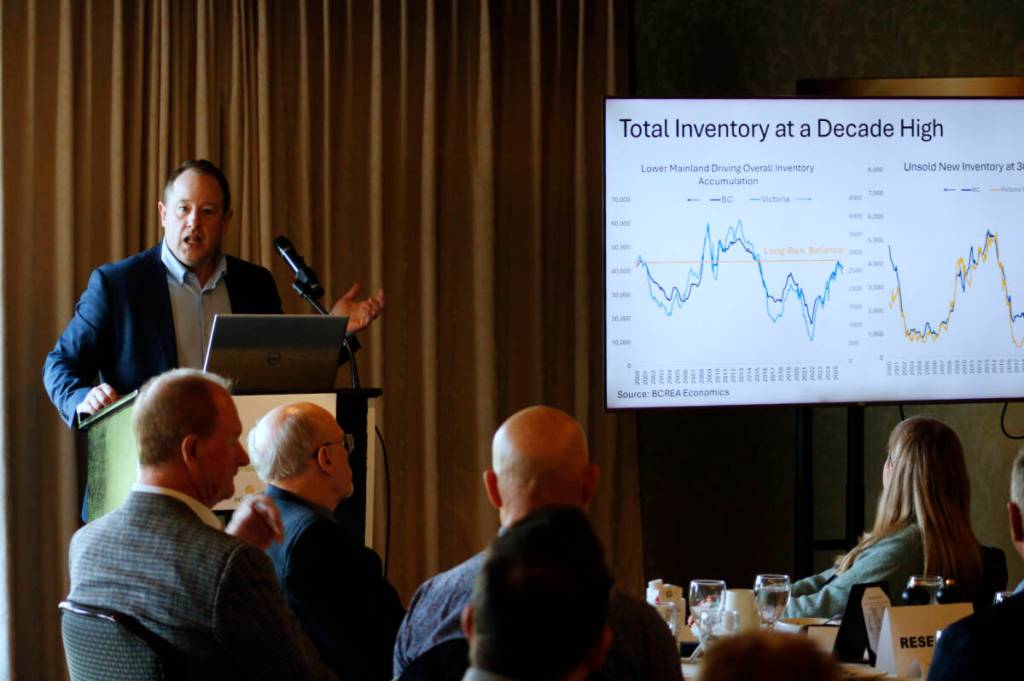
At the start of 2025, according to British Columbia Real Estate Association chief economist Brendon Ogmundson, the industry was feeling optimistic as there continued to be more demand for higher density, and the province hit the 10-year-average of home sales after some years of interest rate-driven slowdown.
“And then uncertainty from tariffs hits in February. Sales fell off a cliff across B.C., largely in the Lower Mainland, and then really struggled to get off the mat all year,” he told the crowd of around 80 industry professionals.
Between January and November 2025, there was a 20 per cent jump in housing starts in Greater Victoria, according to the Canada Mortgage and Housing Corporation, while unit vacancy rose to 3.3 per cent in 2025, the highest vacancy rate since 1999.
Read More: Greater Victoria vacancy rate reaches highest level of 21st century
“Demand was really slow all through 2025, and that meant that we saw supply really start to accumulate. On the resale side of things, we see the level of inventory of active listings that we consider healthy for the long-term. So we want about the level of active listings we have right now,”said Ogmundson. “We want it with also stronger demand or stronger sales, but this level of activism is kind of where we want things to be to keep prices from rapidly accelerating long-term.”
What is somewhat concerning to him is the high level of unsold new units, mostly apartment units, which is the highest level in 35 years in Greater Victoria – something that does not bode well for the slow-growing B.C. economy.
“We’re not able to have a dynamic economy with lots of investment, lots of hiring that’s happening, pushing demand, pushing home sales higher. We’re just kind of stuck in this really low year,” he said.
Along with the sluggish economy, the federal government is trying to lower the number of non-permanent residents in the country, which means fewer renters and fewer buyers.
“Because of all that inventory, because of things like rising development charges, regulations, delays, everything else, we’re really probably going to see a pretty significant slowdown in housing starts over the next two years. Again, if you can’t sell what’s on the market right now, why are you going to start a new project?” he said.
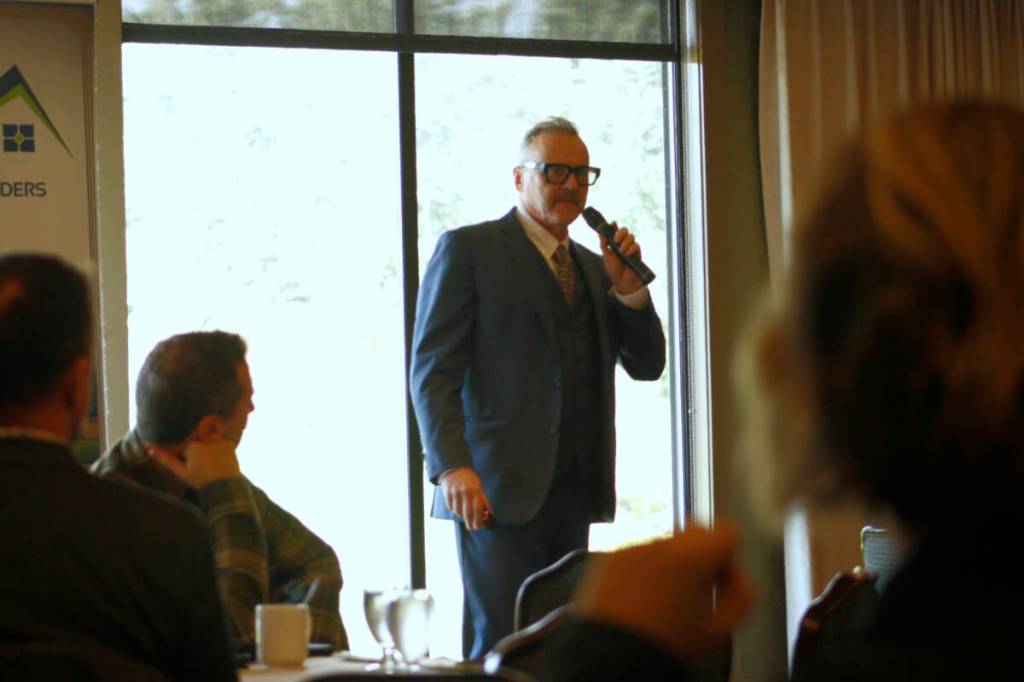
Victoria Residential Builders Association executive director Casey Edge said there has also been a rise in missing-middle housing being built in Victoria, largely thanks to Bill 44, but single-family homes have declined by about 58 per cent in the past five years.
“Missing-middle (housing) represents 4.7 per cent of total new housing in 2025, so while it’s not a big improvement, Bill 44 does reveal municipal zoning bylaws are responsible for obstructing small multi-housing suitable for families. Some municipalities are using high fees, setbacks, etc. to continue to obstruct missing-middle housing,” said Edge.
Read More: Victoria developer says legislation could revolutionize housing industry
He directly called out View Royal, Metchosin, Highlands, North Saanich and Central Saanich for not “pulling their weight,” also naming 14 Greater Victoria council members who voted to add up to $9,040 in development cost charges through the Capital Regional District water commission.
“The public often believes it’s all about zoning, but the challenges are much more. I suggest anti-growth must also pay for growth,” he said, adding “anti-development councils should be contributing significant amounts towards DCCs in Langford and Colwood to lower the cost of new housing.”
He said the industry is resilient, but as housing starts to slow down, he says change is needed, starting with the October municipal elections.
“Those with real-world housing expertise must consider running. If there is only one knowledgeable councillor on each council, especially in the core municipalities, these issues of obstruction, unreasonable demands, and high costs can be articulated in the most important public forum, the council table,” he said.
According to Royal LePage’s fourth-quarter report for 2025, the aggregate home price for Greater Victori was flat year over year, decreasing just 0.1 per cent in Q4 of 2025. On a quarterly basis, the aggregate price decreased one per cent from Q3 2025. The median price of a single-family detached home decreased 2.2 per cent year over year to $1,246,200, while the median price of a condo unit increased 1.2 per cent year over year to $527,100.
Do you have something to add to this story, or something else we should report on? Email: bailey.seymour@vicnews.ca